Talent Tech Labs Takeover: Meet the New TA Ecosystem 13


Episode Summary:
Sorting through the rapidly advancing field of recruitment technology and the even faster growing world of AI-powered tools, can be a dauting challenge for workforce leaders. Talent Tech Labs eases organizations through the intricate capabilities available and provides a strategic approach to the best tech stack for their business needs. Talent Tech Labs’ Co-founder Brian Delle Donne and Practice Leader of Research David Francis take over the Subject to Talent podcast to introduce the new Talent Acquisition Ecosystem 13 and the upcoming Extended Workforce Ecosystem webinar, and share how Talent Tech Labs' advisory arm helps transform how work gets done.
Transcript:
Allegis Global Solutions presents the Subject to Talent Podcast, a hub for global workforce leaders to unleash the power of human enterprise. Listen in as we explore the most innovative and transformational topics impacting businesses today.
Hello and welcome to the Subject to Talent Podcast. Today, we're excited to hand over the mic to our partners at Talent Tech Labs, a QuantumWork Advisory company and part of the comprehensive suite of brands under Allegis Global Solutions. They'll share insights into their new Talent Acquisition Ecosystem 13. Guest host, Brian Delle Donne, Co-founder of Talent Tech Labs, has been a leading force in driving innovation throughout his career, working with several engineering and IT services companies. He will be joined by Talent Tech Labs' Practice Leader of Research David Francis, a world-renowned expert in talent acquisition technology, as well as near and long-term technology roadmap strategy and in-depth trend analysis. Let's listen in.
Brian Delle Donne: Hello. My name is Brian Delle Donne. I'm the Co-founder of Talent Tech Labs. And your guest host today on this episode of the AGS Subject to Talent Podcast. This is actually a return performance for me, so I'm happy to be here doing this again. But this time I'm being joined by my colleague, David Francis, who is the practice leader of our research practice at Talent Tech Labs. And he's an expert in talent acquisition and talent management technologies, and providing advice to the clients who use these tools, trying to perform better in the way they deliver services to their stakeholders. Welcome to the podcast, David
David Francis: Hey, thank you, Brian. Great to be here. And I guess you've set the bar high since you got invited back. We'll see if I get similar treatment.
Brian Delle Donne: I'm sure. Well, let's jump into it. And by way of background, a little bit of my history. I've spent the last 25 years in the human capital space in executive roles in IT staffing, engineering services, solution delivery.
And then 13 years ago, I co-founded Talent Tech Labs. And we did that for the reason that we saw so much new technology coming into the talent acquisition space that it was overwhelming. And so, there was concern that people were seeing all this innovation but not necessarily knowing how to make good use of it. And so, we started the company really to try and bring clarity to the space, to help people better understand what these tools could do and how they could go successfully applied in their organizations. And so, that was the genesis of Talent Tech Labs.
To bring the story fast-forward, our second investor when we went out to raise money to grow the company was Allegis Group. And so, we've had a very long-standing relationship with Allegis. And over the course of time, they sat on our board for about 10 years. And then about almost two years ago, made the decision to acquire the rest of Talent Tech Labs. And so, we fit into the Allegis Global Solutions business and we're coupled up with the group called QuantumWork Advisory. QuantumWork Advisory is a purpose-built advisory firm that helps customers understand where the friction exists in their processes. And then helps them execute technology implementations, so that they're able to get the most out the technology that they've invested in.
So, Talent Tech Labs is the tip of the spear in that QuantumWork relationship, where we have our ear to the ground to understand the technology that's coming to market, understand how it works, where it works. And then we're able to bring in our colleagues at QuantumWork to help our clients be really successful at selecting and executing the technologies they've decided to invest in.
So, David, why don't you give us a few words about your background, because it's really been illustrious. And we're so happy to have you on the team, I guess for what, the past seven years now?
David Francis: That's exactly right, Brian. Yeah, thanks a lot. Hey, I had a circular entrance into the industry. I actually started my professional career in this industry doing market research on the contingent workforce industry. And so, originally, I was an analyst and cut my teeth doing things like staffing firm performance benchmarking, and market share lists, and forecasting, industrial growth, et cetera. So, really enjoyed doing that.
When I was there, it was the beginning of what was seen as some pretty disruptive trends in the staffing industry with the rise of things like talent platforms – online talent platforms, I should say – and new ways of intermediating work.
And so, started doing some research around the technology that was coming to the space, what was disruptive, what was opportunistic. Built out a technology practice while I was there. And at a conference, I believe I was doing a presentation specifically on strategic opportunities and risks related to technology in hiring. Met Brian and we kind of hit it off. Shared a little bit of some of the fun stuff they were doing at Talent Tech Labs, so decided to join Talent Tech Labs, build out the research practice. And it's been a fun and exciting roller coaster ever since.
Brian Delle Donne: And it's been great to have David on the team. When we were a startup, we were just really rubbing two sticks together to try and understand what was going on. But when he came to the company, we really were able to double down on our research chops, and built a really robust research and advisory business on the back of the expertise that he and his team have grown up to provide the company.
So, let's go back to the beginning. Our mission was to try and bring clarity to the space. And one of the first things we did was come up with an infographic that plotted out the technologies across the talent acquisition continuum. And so, in your mind's eye, just think about a little placemat that identifies where all these technologies come to life.
The first version of this was actually some sticky tabs on our office wall in New York. And fast-forward today, we're up to Ecosystem version number 13. So, almost one a year has been our release frequency. So, David, help the audience understand visually, if you can, what that ecosystem looks like and what makes it important to understand how the space lays out.
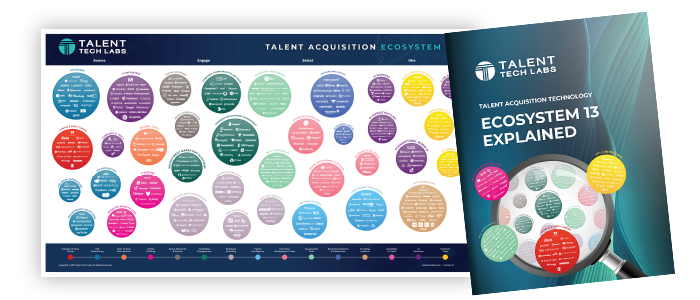
Under one of those verticals, you have all the point solutions or individual categories. We call these sub verticals. And these tend to be companies that would show up together. If a company was going out to do a request for proposal (RFP) or if they're looking at a particular solution space, it should be companies that have similar features and functionality and would commonly show up together in RFPs. So, as an example under, again, job advertising — you have things like job boards, programmatic advertising, job distribution, et cetera. And then inside of each of those sub verticals, you have the collection of vendors associated with those particular sub verticals.
Now, one of the design decisions we have made is [in regard to the placement of vendors]. If you look through, we've got quite a few vendors. I think more than 500 in our talent acquisition technology ecosystem. You'll see that there's one vendor in one sub vertical. And it was an intentional design decision to do this, because, Brian, before part of our mission or founding ethos was we wanted to help practitioners and organizations cut through the noise and get a sense of what companies actually do. And in most cases, if you ask a company what they do, the answer is yes. And so, not particularly helpful from trying to make a decision point.
And so, while there are many cases where a particular vendor might have – and we're seeing this more and more actually as it's become easier to develop – but a vendor may have offerings in multiple different sub verticals or capabilities in multiple different sub verticals. We identify them in the category from which we think they derive the majority of their business, or it's the main reason or solution that customers are actually buying. And from a practitioner's perspective, I think this is really useful in a couple of things. First off, it just gives a really clear, succinct way to understand the layout of the land, who does what. And also, we put a great deal of thought into which particular vendors actually do or don't make it onto the ecosystem. And so, it can be useful, too, to gauge a sense of who's impactful or innovative in the space as well.
Brian Delle Donne: Thanks for that. A little hard to visualize. So, if you want to get a quick snapshot, just go to talenttechlabs.com and you'll see a dropdown that allows you to look at the ecosystem. There's an interactive version of it there. So, it had been rocking along over the years. And it's really withstood the test of time, because the way we've characterized those pieces of functionality across the ecosystem have become industry nomenclature as to how you describe functionality. So, it's pretty ruggedized. It's pretty tested by the market. And it's, like I said, withstood the test of time. We see it showing up in people's offices all across the country, and so it's gotten out there virally. And so, we're really pleased about that. But there's a big change that happened, a couple of big changes that happened from Ecosystem 12 to [TA] Ecosystem 13 that I'd like to drill in today with David. So, why don't you talk structurally, David, about what's happened with the growth of the extended workforce, and what that caused us to do and the way we characterized the space.
David Francis: Yeah, sure. So, for some historical context, even since our early days, we always had a lens on towards what was happening in the external workforce. In a lot of ways that includes basically the hiring of non-full-time employees, essentially of all different kind of category types. So, freelancers and have been contractors, temporary staff log, et cetera. And the source to hire workflow is actually relatively similar in both of those environments. And both of those constituents are big users of technology. And so, we've always had a lens on the extended workforce, and the technology related to support it. I believe it was Ecosystem 11. It was a couple of years ago, we broke out the technology that was specifically focused on the extended workforce. And we created this wave at the bottom and it gave a little bit better sense. Like, okay, what are tools that are designed for talent acquisition teams and full-time hiring? And what are the tools that are designed for the extended workforce teams, and hiring and managing that particular category of labor?
One of the things we learned and found is that as we've worked more with the teams responsible for managing that particular category of labor, is that the use cases and the workflows, it's so nuanced and it's so different than talent acquisition. Even though there's a talent acquisition component to it, it really is a different beast. And even in areas where there's overlaps in categories. So, people use assessments or teams use assessments to qualify candidates in their full-time hiring. And that's a category of tool that's also used in contingent labor. But in even the cases where both are using assessments, the specific vendor mix actually tends to be different, because the features and functionality that you build to support those different audiences is going to be different because the workflows of those two audiences are different.
So, anyways, net-net, we thought that the extended workforce ecosystem as a category is important enough that it really needs its own standalone ecosystem. It shouldn't be a footnote in the Talent Acquisition Ecosystem. So, what we decided to do is we removed all of the extended workforce-related sub verticals from Talent Acquisition Ecosystem 13. And we are going to be launching a new standalone contingent workforce ecosystem, which we think is going to be a lot more valuable to the practitioners that are responsible for managing that particular space.
Brian Delle Donne: And that's coming out pretty soon from what I understand. And typical in our product releases like this is we put out an explainer report which helps people understand what makes up the space and what's changed. And so, David, I know you're working on that now, but I'm sure that there'll be a webinar to announce it. And hopefully, we can get you all invited to be able to listen in on that.
But besides that structural change, there's a lot that's gone on this ecosystem that's changed as a result of the emergence of AI. On Ecosystem 12, I think we had AI addressed basically in two bubbles, maybe three. I think one was called generative AI, one was AI audit tools, and I think the other one might be RPA, robotic process automation. But in [TA] Ecosystem 13, what happened, David, we went up to five or seven bubbles?
David Francis: Yeah. So, last year, we had a couple of bubbles. So, first, it's just a clarifying point, Brian. AI has been in the industry since the industry was founded. And so, there've been AI solutions or companies that are providing AI solutions in our ecosystem since we started creating the ecosystem. What changed was the rise of generative AI and large language models, which provided a fundamentally different approach to how you can embed AI in your systems or deploy those solutions to end clients. And there's been a renaissance in terms of capabilities and new solutions around that. So, with that context, last year we had generative AI as a standalone category. We had AI algorithm and audit as another one. This year, we launched an AI solutions vertical. And so, basically, an entire solutions space where the bulk of the features and the functionality related to AI capabilities. Foundational models or generative AI models are still in that vertical.
We changed the name to foundational models to better reflect the foundational role that they play in a lot of upstream or I should say downstream solutions. And we launched several new sub verticals. So, AI recruiters, these are tools that organizations use to automate using agentic AI capabilities, some part or possibly all of the recruiting process or what normally a human recruiter, sourcer or a coordinator would do. We launched AI workers, which is a solution category designed to basically be deployed inside of companies where an AI agent can take on parts of work that was formerly done by humans. But it doesn't necessarily need to be in the talent acquisition department or HR department. So, it could be things like an AI sales agent, AI software developer, AI medical scriber, AI research analyst, things of that nature.
We launched a new category, which has really only been around for probably the past 18 months or so for candidate AI tools. And this is an emerging category of tools that may be the bane of existence for many large organizations struggling with an influx of applications that are AI assisted or candidate fraud in the application process. I mean these are really tools designed to help candidates apply in mass for jobs, custom or hyper personalize their application. And then in the actual interview process or selection process, they're providing in some cases real time feedback for things like interview assistance, et cetera. We kept AI and algorithm audit. That's a category that's continued to grow. And the last category we added was AI infrastructure. And these platforms are a different flavor of the AI solution.
Basically, they're generalist AI agent builders, typically, or most notably offered by the largest technology companies, like the Microsofts, and ServiceNows, and Salesforces of the world. But basically, what they let organizations do – or practitioners inside of organizations – is build their own custom agents in a no-code environment to find the rules and guard rails around how those agents are deployed, or what they're able to do, or what systems they can interact with. But it basically lets them build their own custom AI workers on demand and then get charged piece meal for it, based on the utilization of work that those agents actually do. So, a lot of change and a lot of exciting innovation happening, particularly around AI solutions, Brian.
Brian Delle Donne: So, how many companies do you think we've added to this ecosystem over the last one?
David Francis: It's a good question. I think even with the removal of all of the contingent workforce related sub verticals, I think we still ended up net right near or above where we were at last year vendor-wise. So, we've added, I think more than 100 new solutions. There's also several companies that get removed each year for a variety of reasons. Some get acquired, some go out of business, some don't meet the qualification, et cetera, for inclusion. So, quite a lot of vendors added this particular year, which also necessitated some of the changes we made structurally to make the extended workforce its own ecosystem, because the infographic itself was getting pretty busy, quite frankly.
Brian Delle Donne: So, I want to come back to the area of those candidate tools, because I can't be in a conversation with a staffing executive, an MSP, an RPO or a talent acquisition team who isn't really paranoid about what these tools are doing to either really create the Hollywood resume, inflate capabilities or what that has done to facilitate the emergence of fraud in the way people are showing up in ATSs and on job boards. So, any advice there to the buyers on how to combat these tools in the candidate's hands?
David Francis: Yeah. Yeah. I've got a couple of thoughts. Maybe before I answer the question directly on strategies for mitigating, maybe a quick philosophical discussion. I think there's a question about my own [opinion] — are these tools good or bad, or right or wrong? My sense is I actually kind of like the fact that now one of the, I would say silver linings of AI coming to market is it's now giving a new tool set to candidates. And so, I don't think it's necessarily a bad thing that candidates have this new tool that lets them be able to apply to more jobs or present themself in a better fashion. And even from an employer's perspective, whether that's a staffing company or direct employer, having more people apply to your jobs isn't necessarily a bad thing. Now, the downside is if people are using it in ways that are unethical or that clearly run afoul of what it is that you're trying to hire for.
So, if people are misrepresenting themselves or saying that they have skills that they don't, or cheating on assessments, or the interviews, then that could be a problem. And so, there's a couple approaches I think I would take. So, first of all, in many interviewing platforms now, in many digital interviewing platforms and assessment platforms, there are ways you can AI proctor an interview or an assessment to…, you can't do this with 100% certainty, but there are ways to basically flag those interviews or those assessments that look like they are using AI to basically cheat the system or cheat in the process. And so, I think that's going to probably become a de facto standard at some point, where you have to incorporate some type of AI proctoring in order to at least get an understanding of [the issue].
And there's some pretty advanced techniques that you can do. But at a minimum, what you want to be able to do is understand and be able to flag who are the candidates that you think were at risk or cheated on a particular assessment or interview. And then you can create whatever follow up you want to do to make a decision one way or the other on that particular candidate.
The other thing that can be baked in natively is large language models, they're basically just prediction engines, and so they're probabilistic prediction engines. But one of the effects of that is that the way that they write is also predictable. And so, there are some tools that are out there with some confidence that you can basically use these to get a pretty good sense – again, not 100% accurate – but to get a pretty clear directional picture of if the content that has been submitted by this particular candidate AI generated or not. And so, you might have that as a filter or a flag right at the get go.
I think the last thing I would say, again, maybe this is all end philosophical, is that I think it might be a miss if the [candidates were not allowed to use AI]. Basically, the decision to be made is to what extent are we going to allow candidates to, or not to, use AI. And I don't know that anybody or many organizations I think at large haven't yet formally decided what their policy is here, but I think there does need to be a policy. And so, in some cases you may have a zero AI policy for how you complete a problem. In other cases, there are organizations that have leaned in and the expectation is like, well, do we even want people that don't use AI applying for our jobs? Maybe not, because that's kind of the future. And so, let's create a structure in which they can use AI, but do it in a way that also complies with our internal policies. So, a little bit of philosophy, hopefully a little bit of tactics, hopefully helpful.
Brian Delle Donne: No, I'm sure that's really helpful. So, David, I'm in conversations with many leaders. And they are just really almost in a state of panic with fear of being left out and maybe not moving quick enough. On the other hand, they're seeing the pace of change happening so quickly they're wondering, when should I lean in? So, before we answer the question of how we might guide those bits of challenge, maybe we could talk about the impact that some of the best tools in this space are having on the processes they're trying to impact. So, maybe if you could just summarize some real high level, which of these tools in the verticals that we talked about, sub-verticals we talked about, is having the greatest impact at this early stage?
David Francis: For AI solutions specifically or just across the board?
Brian Delle Donne: Well, I think we can talk about predictive as well as generative, and then maybe again with the agents.
David Francis: Yeah. Look, I think I'll maybe start the solution set at large and then we'll talk about AI specifically. First, again, I'll maybe unfortunately start a bit philosophical, but impact can be measured a few different ways. And so, typically when we go into an organization, like if we're doing advisory work, part of our mandate is we have to find out what's broken, find out what the challenges are, and then help advise on solutions that can fix those challenges. And typically, if it's a sophisticated organization, you want to have a business case or some ROI associated with whatever new investment that you're going to be making. In the talent space, it can be a little tricky, because there are some things that are very easy to measure ROI on. And there are some very impactful things that are important, incredibly important, maybe, and some might argue the most important, but are a lot harder to assign — first, they're hard to measure and then maybe hard to assign a dollar value towards those.
A couple specific examples. If you're trying to source and you want a direct measurement like, ‘okay, can we increase the volume of quality applicants that we have coming through our pipeline?’ That's a very easy to measure, easy to track, typically easy to associate with what solution was driving that particular result. If you're looking towards which employee that we hired is actually staying on longer, which employee is actually driving business results for our organization. And how do we make the determination for that particular candidate being a high quality candidate or a high potential candidate? That's a lot harder to measure and a lot harder to track. But ultimately, that's probably the most important thing that you want to be doing is hiring organizations, is hiring people that are going to improve your bottom line or drive business results in some way.
So, anyways, just a way to say when you're thinking about how you put business cases together or look at the performance of any of these tools, it's important not just to think about the things that are easily measurable, but also about stuff that's a little bit harder to measure. And making sure that those maybe non-factored costs are getting taken into account.
On which areas are most impactful. Well, there's a lot of investment happening right now around AI, broadly speaking. One of the interesting things that we found, we did a survey where we asked talent leaders to answer a series of questions related to their use, and sentiments towards AI, and AI solutions in the talent space. One of the interesting things that we found is that about three quarters of companies had some kind of a pilot, were planning some kind of a pilot in the next 12 months.
And when you asked them what's their strategy, the vast majority, about three quarters as well had said that they don't have their AI strategy figured out. And so, there was a little bit of the cart before the horse. In terms of where it's been most impactful, for AI solutions specifically, it's tended to do really well in higher volume earlier career contexts to date. But that's also partially driven by the fact that this has been where the pilots have happened typically in a defined population, usually with early career or high volume, more repeatable candidate processes.And so, how extensible that'll be to other parts of the organization that are doing maybe more complex hiring, more senior level hiring, I think the verdict is still a little bit out. But we've seen some early promising results there too.
Brian Delle Donne: That's great. That's really helpful. So, in your view, do you think this accelerated pace of innovation coming to market is here to stay? Is this pace going to be what we have to look forward to?
David Francis: I think yes. And just for a little bit of context. We saw more new vendors come to market in this last iteration of updating the ecosystem than the entire time that I've been here at Talent Tech Labs. And there's a couple of reasons for that. The biggest reason is again, the silver linings or side effects of this new generation of AI that's now available, is it's largely been democratized. And what that means is basically anybody has access to it. And so, it's made that significantly easier. There used to be if you wanted to build a technology company, you used to know how to code and do all these different technical things. You have to raise money. It was pretty challenging. Now it's significantly easier to stand up a solution even among non-technical folks. And so, it's democratized access to literally the best AI that the world has ever known.
And so, on the back of that, there's been this massive explosion in new solutions. And not just in the talent space, but literally across the board. And so, the question that we get asked is, well, there's a couple of questions we get asked. The first one is what you just did, is this enduring? The other one is, if there are so many different new solutions coming to market, who specifically is going to win? So, on your question, Brian, I do think that this trend is enduring. So, if I had to try to articulate the state of the market right now, I would say we are definitely probably an 11 out of 10 on the hype cycle. But at the same time, I think this is going to be an enduring. This technology is transformational, and I think it's going to be enduring, and the pace of innovation's probably only going to accelerate not decelerate.
And so, I'd maybe liken it to a little bit like 1999, where we had pet dot coms in all of their ilk. But we also had generationally defining companies that are now the largest companies in the world that came out of that period, too. And I think that's kind of where we're at today, where it's very early stages and what's probably going to be a many years long transformational process. And I think another thing that's going to happen is a lot of the big companies that are dominant market leaders today aren't necessarily in a safe position. And so, who wins in the future? I don't know which specific vendor is going to win. But if you look at the big categories, like ATS or CRM, or matching or job advertising and sourcing, who wins in each of those categories? That remains to be seen. And just because you're the largest company in the space today, that doesn't necessarily ensure your success or continued dominance five years from now. And so, the pace of disruption has accelerated significantly.
Brian Delle Donne: It sounds like we're in a good business.
David Francis: It sounds like we're in a good business, yeah.
Brian Delle Donne: Really, speaking candidly though, the genesis of Talent Tech Labs is trying to bring clarity. Our job has gotten harder with this pace of change. But we really are putting all of our efforts into trying to keep a level head around what these mean for the market, and what winners and losers might look like so that companies can make the most informed decisions they can on how to structure their technical solutions to deliver the services that they need to.
David, this is great. Maybe tell the folks how they might listen in on some upcoming webinars that we're offering to unpack some of this stuff. I think you got a couple coming up pretty soon.
David Francis: Yeah. we have one we'll be launching. We're doing a webinar on the extended workforce in October. I think it's October 23rd, if I'm not mistaken. So, encourage you to register for that and listen to it. I believe in November, we're launching our third edition of the Talent Management Ecosystem, so we'll have an accompanying webinar. So, welcome to join us for that as well.
Brian Delle Donne: And certainly, you can go to talenttechlabs.com to see our event schedule and the research that we give away for free to help people understand the space. And hopefully, someday we might have the opportunity to support your organization. David, it's been great having you on this call and appreciate the insights you've shared. Hope we have a chance to do it again soon. But thanks for all your contributions today and the insights you've shared with our audience.
David Francis: Thanks so much, Brian. It's been fun. Take care, everyone.
Brian Delle Donne: See you. Bye.
If you enjoyed this episode, please subscribe, rate and review us on Apple Podcasts, Spotify, or wherever you get your podcasts. And if you have questions, send them to SubjectToTalent@AllegisGlobalSolutions.com. Follow us on LinkedIn with the #SubjectToTalent and learn more about AGS at AllegisGlobalSolutions.com, where you can find additional workforce insights and past episodes. Until next time, cheers.
Follow Our Podcast


About the Subject to Talent Podcast
At Allegis Global Solutions, we’re in the human enterprise business. Bridging to the community through our Subject to Talent podcast, we spotlight leading voices from across the workforce solutions industry who are taking bold actions to transform the way work gets done. The views and opinions expressed by third parties, including but not limited to external links on Company web pages, speakers at Company-sponsored events and resources recommended through company resource groups, do not necessarily reflect the views and opinions of the Company, its management or employees.